
Diminishing returns
A reflection on China and its seeming involution (Part I)

A few years back, a short video went viral on Chinese social media.
It showed a student riding his bike while typing on a laptop balanced on the handlebars
He was presumably preparing for class or doing homework while cycling across the Tsinghua University campus.
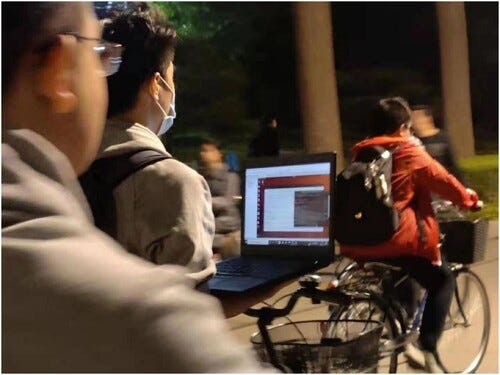
The student was soon dubbed by Chinese netizens as the Tsinghua’s Involuted King: A plastic representation of the concept of “neijuan” (内卷), commonly translated in English as “involution” - a term that’s taken on a life of its own here, touching everything from the school system to job markets to entire industries.
It’s not new, but these days, it feels newly urgent.
What is involution?
Originally, it was an academic term.
Anthropologists used it to describe agrarian societies stuck in a cycle of increasing effort without meaningful output. In simple words: More labor, same yield.
Today in China, it’s cultural shorthand.
It describes a kind of self-defeating competition.
Where effort doesn’t get rewarded and where doing more doesn’t get you further. Just… more tired.
Now, it is worth pointing out one very important issue.
For almost three decades, China has seen incredible growth. A land of opportunities, where hustling would almost always produce returns.
Three decades means an entire generation.
In China you have an entire generation of people who grew up being told that the harder you work, the further you’ll go in life.
Study hard, and you’ll go places. Work hard, you’ll go far.
But things have been changing.
Let’s take a quick look at the big picture
Over-simplifying complex matters here.
China is maturing, fast, and that break-neck economic growth is naturally slowing down:
GDP growth for this year is down to 4.8% and projected to 2026 at 4.5%
Property investment is still declining (-9.8%) due to continuing weakness in real estate markets, weighing on growth.
Infrastructure investment has been growing at a steady but moderate rate, while manufacturing investment has been robust on the back of strong export demand.
Industrial production has been robust, driven by high-tech industries (+5.9%).
Consumption growth is sluggish due to on-going high precautionary saving.
Demographics are shifting - impacting especially the number of working-age individuals:
Aging population: >16% population aged 65 and above
Shrinking working-age population (15-65 years)
The labor market is becoming increasingly challenging: While China overall unemployment rate remains somewhat stable around 5.10%, in June 2023 the youth unemployment rate peaked at 21.3% - the number was so staggering that the government stopped publishing it for some time. In November last year, the National Bureau of Statistics resumed doing so with adjusted metrics, showing it still remarkably high at 17.1%.
Why does this matter?
Think back to my previous statement: There is an entire generation of people who is experiencing this slow down and feels like all their efforts were for naught.
That their parents’ promise “study hard and you’ll be successful, work hard and you’ll go places” cannot be fulfilled any longer.
Mind you - it’s a feeling. But sentiment shapes economy, too.
The most talked-about arena is education.
Parents enroll kids in endless extracurriculars.
Students pull all-nighters to edge ahead by a fraction of a point.
Schools pile on pressure.
But despite it all, university slots remain fixed, and the advantages feel increasingly marginal. Even elite credentials don’t guarantee a job anymore.
But it doesn’t stop there.
Look at tech firms or EV makers.
The price wars between companies like BYD and Xiaomi are sometimes framed as heroic battles for market share.
In reality, they also reflect a deeper anxiety: if you’re not pushing harder, you’re already behind.
And inside these firms?
Engineers doing 996 (shorthand for companies where you work from 9.00AM to 9.00PM, 6 days a week).
Teams launching three products a quarter just to stay competitive.
The problem is, that kind of treadmill competition burns people out and erodes margins. Without producing much lasting value.
The government listens.
Government censorship in China is constant and quick to react. Public dissent rarely stays visible for long.
But after years living here, I’ve noticed something else: while the government suppresses uncomfortable voices, it often pays attention to what they’re saying.
The clearest example came in late 2022, when protests erupted against the potential return of Covid-19 lockdowns. The government moved fast to shut them down, online and on the streets.
And yet, within weeks, every major policy was rolled back. The ubiquitous testing booths across cities like Shanghai vanished almost overnight.
The message was silenced, but the message was heard. The government acted quietly, but decisively, in response to public pressure.
This seems to be happening with involution, too.
The Chinese government has started to acknowledge the toll of involution, especially among students and young workers.
A few recent policies suggest attempts to address it. Progress is, however, mixed.
July 2021: The “Double Reduction” policy
What it aimed for: Reduce the academic pressure on students and move beyond a test-driven education culture.
What happened: The tutoring sector collapsed. One study conducted by two Chinese scholars (Wang Qichao, Wo Xiaotong) estimated around 10 million job losses.
A policy meant to ease pressure on youth ended up hitting young graduates hardest.
December 2024: Central Economic Work Conference – “Rectification of involutionary competition”
What it aimed for: Shift local governments and companies away from cutthroat competition and toward innovation.
What happened: Some provinces, like Zhejiang, began piloting a 4.5-day workweek.
It's an interesting signal, but still more of an experiment than a shift.
March 2025: “Special Action Plan to Boost Consumption” (State Council)
What it aimed for: Improve work-life balance by curbing excessive working hours.
What happened: Too early to say. Implementation details are unclear, and outcomes haven’t surfaced yet.
These steps show that the issue is on the government’s radar.
But so far, the gap between aspiration and result remains wide.
Involution is a personal affair.
What strikes me most, in all the conversations I’ve been having lately with professionals, business leaders, and educators, is how personal this all feels.
Involution is something people are living every day. It’s far from being an abstract concept.
The sense of running hard and not getting anywhere.
The quiet fatigue of teams doing too much, for too little gain.
The pressure is real, but so is the confusion about what to do next.
There’s no clear roadmap yet, but the questions people are asking feel more open, more honest.
Involution is a scary, and fascinating feature of Chinese society today. And it matters - because it may be redefining what the social contract between Chinese and their government will look like in the years to come.
I will continue exploring this topic in future posts.
Until then, I would love to hear from you: What’s your take on involution? Is it a passing hype, or should companies and leaders care about it? If so, what should they be doing to address it?
You hit the nail in the head once again! All these are VERY visible on the daily life of a corporate worker in Shanghai in 2025. HR teams scrambling to find ways to engage with young professionals while those with experience run out of steam as everything pivots every week.
We need more unbiased voices like yours with in-depth knowledge and discernment to show us the true big picture. Specially when it comes to holding accountable or praising the Chinese Gov when they do something right - not many people doing that anywhere in English.
Keep it up!